 Book a Demo
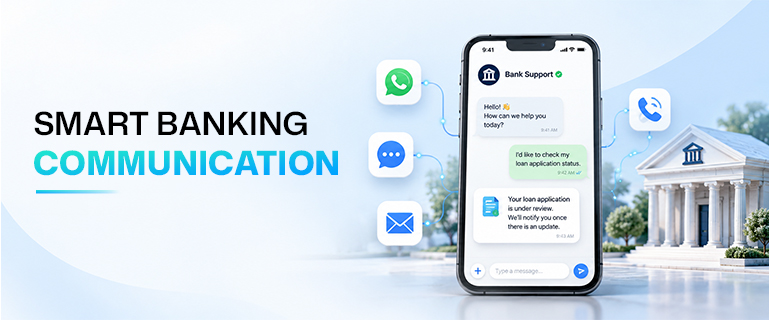
Imagine a situation where you needed some assistance from your bank. Perhaps you wanted to inquire about any transactions or about your loan application or even some debits that you did not know about.
Chances are, you didn't want to visit a branch. You wanted an answer on your phone, preferably without spending twenty minutes waiting for someone to pick up.
Banks understand this shift. The whole idea behind mobile banking is convenience, yet in such situations one would have expected that same level of convenience in receiving the help.
Here is where a customer communication platform would come in handy.
In other words, by integrating SMS alerts, chats via WhatsApp, emails and customer calls, it would become possible to simplify the process of communication. And the outcome will be that there will be a structured process for communication, reducing extra processes for customers.
A customer communication platform allows banks to manage their communications, alerts and service transactions using different channels.
For instance, a customer receives an alert about their transactions through SMS, asks about their personal loan on WhatsApp, and after all these processes, talks to a support executive.
A connected platform may assist the bank in maintaining the context during all these processes.
It should not be just about having different channels for contacting your customers; rather, it is about avoiding starting from scratch each time a new channel comes into play.
Also check: IVR Systems That Improve Banking Customer Support
Given that WhatsApp is now commonplace for conversations, it should not come as a surprise that banks have begun providing some of their services on this platform.
The WhatsApp Business API for Banks gives banks an opportunity to engage in automation conversations based on various services such as account inquiries, branch inquiries, loan application status, among others.
In cases where customers want to know about their loan application status, they do not need to call a dedicated number. This query could possibly be resolved using WhatsApp.
Of course, sensitive requests still require appropriate verification and secure banking workflows.
Imagine applying for a personal loan and hearing nothing for several days.
It is not known to you whether your documents have been received or whether verification is done or if any other information is needed.
Of course, the next thing would be to contact customer support.
Now consider that you are regularly informed throughout the entire process.
Application received. Documents verified. Application under review. Decision available.
This is one example of how a customer communication solution could send such notifications at various stages.
The banks could use SMS, WhatsApp, and email based on the message, preference of the customers and channel consent.
This is a minor change that will make the entire process far easier.
Every banking query does not necessarily require a customer service executive.
Customers usually have questions related to branch timings, availability of services, application status, and basics of banking.
These queries can easily be sorted out by automatic assistants, leaving the team free to sort out complex queries.
However, there is a limit to which automation can go.
A query related to fraudulent activities or unusual transactions will require immediate attention by a human assistant.
Major banks understand that the best use of automation technology does not revolve around making sure customers do not leave the chatbots. It is all about enabling users to reach the right conclusion-or the right person-as effortlessly as possible.
The customer initiates a query via WhatsApp, but switches to a call to the bank at some point.
What then?
In a siloed process, the executive may not be aware of the previous exchange. The client will explain everything from the beginning.
An omnichannel communication platform for banks can help authorised teams access relevant conversation history across connected systems.
Such a solution is particularly useful for complex journeys across different departments like applying for loans or disputing credit cards.
The customer sees one bank. Its communication systems should support that experience.
The need for trust is magnified when there is money involved.
Consumers need timely communication about any suspect activities in their accounts, as well as anything else related to security matters.
Communication tools can assist banks in sending such alerts using the right channels and directing consumers to a proper solution path.
For instance, suspicious transactions on a consumer's bank card should trigger a message that will instruct a consumer to examine their account using an official bank channel.
Such a message should be recognizable and actionable.
However, banks have to ensure security of their clients' data and should not ask for credentials via regular messages.
Fast communication matters. Equally, secure communications are also very important.
A college student exploring an education loan and a working professional enquiring about a home loan probably don't need the same information.
Yet generic campaigns tend to treat them all the same.
With appropriate customer consent and the necessary data at hand, banks could communicate according to customer interests and needs at different stages of the customer experience.
A customer investigating a loan would find a guide to loan eligibility more valuable. Someone who has already applied would probably find a status update more useful.
The idea isn't to message customers more frequently.
It's to give them information that actually helps.
The move towards conversational banking is not unique to Indian banks.
A recent case study revealed how FirstBank made use of personalized text messages for transactions, balances, and other account details. Belfius used conversational AI to simplify insurance claims, and Argenta Group used the automated assistant for answering customer inquiries.
These are just a few instances of using a similar strategy of leveraging communication technologies to make banking less complex, yet offering human assistance when needed.
Managing communications through various channels becomes difficult for banks with an increasing number of customers.
Pingverse makes it possible to integrate WhatsApp, SMS, RCS, Email and Voice into one communication system.
Using APIs, automation and omnichannel, banks can create journeys around transaction notifications, application updates, customer queries and customer engagement.
In order to ensure effective management of communications for the bank internally and for the convenience of customers.
Communication in banking works effectively if the correct information is sent to the correct individual at the correct time.
The answer to the question of how banks can leverage the customer communication platform is not solely dependent upon chatbot and automated messaging alone.
In fact, the key to doing so is ensuring that the customer receives up-to-date information, avoids redundancy in questions, keeps the conversation flowing, and facilitates access to customer support.
Regardless of whether it is an account update, a message on WhatsApp, or even a call to customer support, these little things can go a long way in terms of how customers view their bank.
At times, it is the small changes in communication that have the most profound effect on customers.
Ready to make every customer conversation simpler and more connected? Connect with Pingverse to bring WhatsApp, SMS, RCS, Email and Voice together on one platform, and see how your bank can deliver faster, clearer communication.
A customer communication platform in banking is software that helps in managing customer communications via various channels such as WhatsApp, SMS, email, and voice. With the use of a single communication platform, banks get the ability to coordinate customer notifications, automate routine customer enquiries, etc.
The uses of customer communication platforms in banks include transaction alerts, loan application status updates, payment reminders, customer support notifications, and other similar purposes. With the help of customer communication platforms, banks also automate routine interactions and responses to enquiries and other issues.
Banks make use of the WhatsApp Business API to assist customers automatically, send pre-approved notifications, and facilitate two-way customer interactions. Customers have the freedom to enquire about some selected banking services or loan applications using WhatsApp channel. This is after going through the necessary verification and security processes.
Since customers may not necessarily rely on one channel all the time in banking, there are instances where customers receive an SMS notification, initiate a question via WhatsApp and then contact customer support via a call. For this reason, an omnichannel communication platform for banks becomes necessary.
Pingverse is one platform that brings together WhatsApp, SMS, RCS, email, and voice under one communication ecosystem. With Pingverse, banks are able to make use of its APIs and automation features to handle customer notifications among other interactions.