 Book a Demo
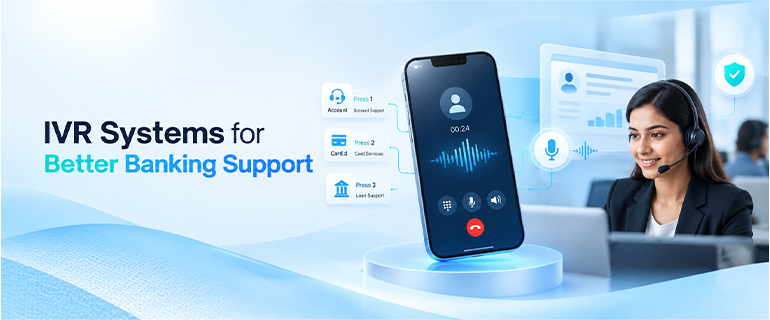
There are plenty of things banking customers are happy to do digitally. The checking of their account balance, the initiation of payments and the downloading of statements can normally be done using an application in just a few seconds.
However, the very second when anything becomes urgent - such as their card going missing, the need to identify an unfamiliar transaction or payment - the importance of their phone becomes apparent once again.
The difficulty is that old-fashioned phone service tends to make any inquiry into a waiting game.
Today’s IVR solutions are built to change all that. Instead of just being the endless game of “Press 1, Press 2,” they have the potential to assist in completing common customer tasks and to recognize why customers are calling and direct them to the appropriate representative for more complex queries.
For banks and financial institutions, the opportunity isn't simply to automate more calls. It's to make every voice interaction easier.
Interactive Voice Response lets people interact with an automated telephony system using either keypad inputs or voice responses. IVR in its current form will be able to handle simple questions automatically and forward difficult questions to an agent where necessary.
Here’s what your typical customer journey in the banking sector looks like:
Customer calls → Identity verified → Need identified → Self-service or agent support
It would have enabled them to verify a service request, access some general information on their account, report a missing card or contact the right department.
More modern IVR systems also incorporate artificial intelligence (AI) and NLP technology, enabling the customer to specify his/her needs without going through a series of menu choices. The source also refers to AI, NLP, predictive routing and CRM-based customization as innovations in banking IVR.
Also Check: Top 7 Use Cases of Business Voice API in India — From OTP to Customer Support & Lead Generation
The distinction matters. Good IVR shouldn't put another barrier between the customer and the bank. It should remove one.
Not every customer call requires an agent.
Banks routinely receive questions about transactions, applications, service requests and other relatively straightforward matters. When every one of those calls enters the same agent queue, customers wait longer and support teams spend time handling repetitive work.
Well-designed Inbound IVR & voice call solutions can automate suitable routine journeys and keep human agents available for cases that genuinely need their attention.
Research on banking IVR identifies faster access to routine information, reduced operational workload, high-volume call handling and consistent service as important benefits.
That creates a better balance:
Automate what is predictable. Keep people available for what isn't.
We've all experienced the frustrating version of IVR:
Press 1.
Then press 4.
Then press 2.
Wait.
Finally reach an agent-and explain everything again.
Intelligent routing can make that journey considerably shorter.
A customer calling about a lost card should reach the relevant support journey quickly. Someone asking about a loan application shouldn't have to navigate through unrelated account options first.
Modern systems can combine customer inputs with available context to make routing more useful. Predictive routing can also help direct complex queries to appropriate human agents.
The best IVR experience is often the one customers barely notice.
An IVR becomes much smarter when it isn't working alone.
With a Voice API for business, voice capabilities can be connected with authorised business applications, CRM systems and customer workflows.
Imagine a customer who already has an open service request. If relevant context is available to the voice workflow, the customer shouldn't necessarily have to start from zero when they call.
Personalization through CRM is another way of customizing IVR conversations, and linking up with other channels for the customer will increase consistency.
This is crucial in today's banking world, as the customer journey could involve going from an app, SMS, WhatsApp, email, to even just a telephone call.
The channels may change. The context shouldn't disappear every time they do.
Banking communication has an additional challenge: convenience cannot come at the expense of security.
A Voice OTP service for businesses can support selected authentication journeys by delivering a one-time password through an automated voice call.
It can be particularly useful as part of a thoughtfully designed authentication or fallback flow, depending on the institution's security policies, risk controls and applicable requirements.
The important point isn't to add verification everywhere.
It's to make authentication appropriate to the action the customer is trying to perform.
Voice communication doesn't always begin with the customer.
An Outbound voice campaigns platform can support automated calls for appropriate customer journeys such as payment reminders, service notifications, application follow-ups, feedback requests or other time-sensitive updates.
But more calls don't automatically create better engagement.
Outbound voice works best when three things are clear:
Why this customer? Why this message? Why now?
For banking and financial services, consent, communication preferences and applicable regulatory requirements also need to be built into the workflow.
Relevance should come before volume.
Sometimes two people need to communicate without needing direct access to each other's personal phone numbers.
An IVR & call masking solution can support selected workflows by using an intermediary number or communication layer instead of unnecessarily exposing personal contact information.
For financial institutions working across service teams, partners or distributed operations, this can add another privacy-conscious layer to customer communication.
Call masking isn't a replacement for broader information-security controls, but it can help reduce unnecessary exposure within appropriate calling journeys.
Automation has a natural stopping point.
A customer checking a routine status may be perfectly comfortable with self-service.
Someone reporting suspected fraud probably has a very different expectation.
The source material highlights maintaining access to human agents as an important part of effective IVR implementation and recommends keeping menus simple, using natural language and providing straightforward agent access.
A well-designed system therefore doesn't try to contain every call at any cost.
It asks a better question:
Can automation resolve this properly, or would a person provide the better experience?
An IVR shouldn't be considered successful simply because it answers calls.
Consider what your customers actually encounter.
There are other aspects that could prove useful in this regard, such as FCR (First Call Resolution), AHT (Average Handling Time), call containment, abandonment rate, and CSAT (Customer Satisfaction).
These could prove useful in understanding the challenges that face customers and in figuring out which type of questions suit the self-service channel.
If callers consistently abandon the same menu, the solution isn't necessarily another menu option.
Sometimes the journey simply needs to be redesigned.
At Pingverse, voice isn't treated as an isolated communication channel.
Pingverse helps businesses bring voice together with channels such as SMS, WhatsApp, RCS and Email, creating more connected customer communication journeys.
For banking and financial services, capabilities such as Voice API for business, Outbound voice campaigns platform, Inbound IVR & voice call solutions, Voice OTP service for businesses, and IVR & call masking solution can support different stages of the customer journey-from authentication and self-service to notifications and agent interactions.
The larger goal is straightforward:
Get the customer to the right answer, action or person with fewer unnecessary steps.
That's what intelligent voice communication should ultimately achieve.
The best banking IVR isn't necessarily the one with the most automation. It's the one that understands where automation genuinely helps.
At Pingverse, we believe routine requests should feel effortless. Urgent queries should reach the right place quickly. Customers shouldn't repeatedly provide information the organisation already has. And when a conversation requires empathy or judgement, reaching a human shouldn't feel like finding a hidden exit.
With connected APIs, intelligent routing and thoughtful automation, Pingverse helps voice become a much stronger part of the banking customer experience.
Because when someone calls their bank, they aren't interested in how sophisticated the IVR is.
They simply want to be understood, and helped.
An IVR (Interactive Voice Response) system lets customers interact with a bank’s automatic phone system using keypad or voice prompts. The system can answer common questions, provide customers with self-service and connect them with the relevant agent in case of complicated requests.
The IVR system may help decrease waiting times because it answers routine questions and connects customers with the relevant department. It will also be useful for dealing with a large number of calls while keeping human agents free for other tasks.
A Voice API for business allows organisations to integrate calling capabilities into applications, CRM systems and customer workflows. For banks, this can support automated voice journeys, IVR interactions and more connected customer communication.
A Voice OTP service for businesses can deliver one-time passwords through automated calls as part of selected authentication journeys. An IVR & call masking solution can help protect privacy by allowing communication without unnecessarily exposing personal phone numbers.
No-and it shouldn't. IVR works particularly well for predictable and repetitive requests, while complex or sensitive situations may still require a human agent. A good IVR makes that transition easy instead of trapping customers in automation.