 Book a Demo
Marketing technology has grown increasingly advanced. Companies now have at their disposal, not only RCS, but WhatsApp, email, push notifications, social media, and conversational AI, and an ever-expanding number of platforms trying to get customers' attention.
Yet, SMS remains relevant and up to date.
This has been made possible because of one simple fact: SMS eliminates friction.
No apps need to be downloaded, no accounts need to be created, not even an internet connection is necessary. This makes it compatible with smartphones as well as feature phones, via mobile carriers' infrastructure.
By 2026, this simplicity may mean one thing important to businesses: communication ROI.
Consider all that needs to be aligned for other digital touchpoints.
Email needs to get through amidst a flooded inbox. A social media post is largely reliant on algorithms and users' actions. Push notifications require an installed app with permissions enabled. Rich messaging experiences may depend on device and network support.
SMS takes a shorter route.
The message goes directly to the messaging inbox on the smartphone without depending on WiFi, internet connection, applications being installed or logging in.
This becomes increasingly relevant in scenarios where timely communication is important.
One-time password valid for only two minutes. A payment reminder due today. A delivery arriving in an hour. An appointment tomorrow morning.
At times such as these, businesses don't need the most advanced form of communication. What they need is the right message reaching the right person at the right time.
When talking about SMS marketing, you will often come across mentions of 90%+ or even 98% open rates. However, industry statistics show high visibility of SMS messages; however, concentrating on open rates as a key benchmark fails to recognize the big picture.
The key benefit of SMS lies in the small distance between message delivery and user action.
Imagine that a person leaves a product in the shopping cart.
A message like:
“Still interested? Your cart is waiting.”
with a direct link back to checkout creates a very simple journey:
Message → Click → Action
Less steps mean less distractions.
For companies delivering millions of messages, any decrease in friction at each step can make a significant difference in the general performance of the campaign.
Not every business message is marketing.
A Transactional SMS gateway can support critical communication such as:
These continue to be common enterprise SMS use cases because they require high visibility and predictable delivery.
Transactional communication also influences customer experience more than businesses sometimes realise.
A customer may barely notice when an OTP arrives instantly. But they'll certainly notice when it doesn't.
The same applies to payment confirmations, delivery updates and account alerts.
In that sense, SMS ROI isn't always measured by immediate revenue. Sometimes the return comes from fewer support queries, smoother transactions and less customer friction.
SMS used to be associated with manually scheduled bulk campaigns.
That's no longer the whole picture.
With the right SMS API provider in India, businesses can connect messaging directly with their applications, websites, CRM systems and operational platforms.
An event happens, and communication follows automatically.
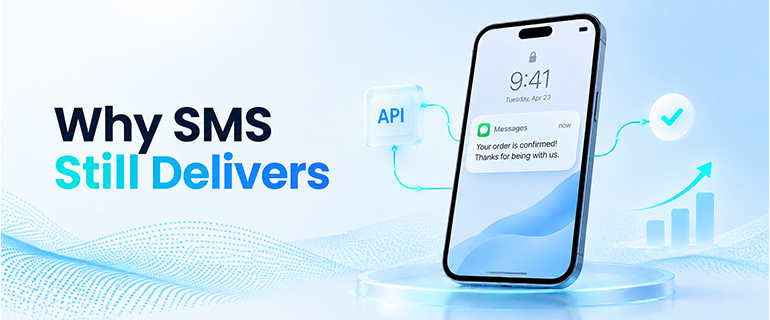
Order placed → Confirmation SMS
Payment overdue → Reminder
Login attempt → OTP
Order dispatched → Tracking update
Appointment approaching → Reminder
Modern APIs allow messages to be triggered automatically by these kinds of predefined business events.
That automation makes SMS more useful because communication becomes part of the customer journey rather than a separate marketing task.
The real opportunity emerges when SMS stops operating as an isolated channel.
Through SMS integration with CRM & platforms, businesses can use existing customer data and behavioural signals to decide who receives a message, why they receive it and when it should arrive.
Imagine an ecommerce customer who hasn't completed checkout.
Instead of sending the same promotion to the entire database, the system could trigger a reminder specifically for that customer.
Or consider a healthcare provider.
If an appointment in the CRM is scheduled, it can automatically generate a reminder on the day prior to the appointment. In case two-way messaging is turned on, the reply from the customer gets connected to the backend of the service delivery system.
That's where SMS becomes much more than “sending texts.”
It becomes part of an automated communication infrastructure.
Also read: Top 7 Enterprise Use Cases of SMS API in 2026
A Promotional SMS service provider can give a business reach, but reach alone doesn't create ROI.
Relevance does.
Sending the same discount to an entire database may generate activity, but it can also create fatigue. A better strategy uses customer context.
A repeat buyer might receive early access.
A dormant customer might receive a carefully timed win-back offer.
A loyalty member might receive an exclusive reward.
A customer browsing a particular category might receive a relevant price-drop alert.
The message doesn't need to be clever. It needs to have a reason for arriving.
Businesses also need to manage consent, opt-outs, sender identities, templates and other applicable regulatory requirements carefully when using SMS for commercial communication.
Permission earns access. Relevance earns attention.
The question shouldn't really be:
“Is SMS better than every other channel?”
It isn't.
Email gives businesses room for richer, longer-form communication. Social platforms are excellent for discovery and reach. WhatsApp can support conversational customer journeys. RCS adds branded and interactive messaging experiences.
SMS solves a different problem extremely well: dependable, low-friction reach.
Even as RCS expands with richer features such as verified sender profiles, images, suggested replies and buttons, device and operator support still matters. The SMS messaging method thus retains its significance as a common protocol and a backup option.
The better question is:
“Which channel is right for this customer and this moment?”
Think of the scenario where a consumer learns about the product via social media, gets information regarding it through an email, gets a reminder via SMS and continues the discussion on WhatsApp.
That's not four disconnected campaigns.
But rather just one journey across four different channels for the customer.
Businesses have begun to integrate SMS along with RCS and email among others depending on urgency, preferences and availability.
SMS is much more effective when it is combined with other channels rather than competing with them.
This is where a modern communication platform can make the difference.
Pingverse enables businesses to integrate SMS, WhatsApp, RCS, Email and Voice into a connected communications architecture.
It enables businesses to move beyond simply integrating SMS as yet another disconnected solution and enables businesses to orchestrate their communications across actual customer events – via APIs, Automation, Campaigns and Channel Orchestration.
It could be either a Transactional SMS Gateway, promotion-based communications or SMS Integration with CRM & Platforms. The goal is simple:
Send the Right Communication, Through the Right Channel and At the Right Time.
If enterprises are assessing an SMS API Provider in India, this additional communications capability becomes critical in ensuring that SMS doesn’t just create yet another isolated channel of communications.
SMS isn’t surviving because businesses have failed to find better technology.
It's surviving because it still solves an important communication problem remarkably well.
It's direct. Widely accessible. Easy to automate. Appropriate for real-time communication, and when combined with customer information and other communication channels, it can do everything from authentications and notifications to retention campaigns.
The future of customer communication is not about replacing SMS with a new channel.
It’s about realizing the places where SMS works well—and making it intelligent in conjunction with everything else.
Businesses can connect their communication journeys through SMS and other channels using Pingverse.
SMS goes directly to the native messaging inbox without needing to download applications or connect to the internet, making it an excellent medium for instant transactions and messaging.
Look beyond message pricing. Consider delivery reporting, routing, API reliability, scalability, automation, CRM integration, template management, security and support for applicable regulatory requirements.
Transactional SMS gateway facilitates automatic sending of service-based SMS including OTPs, confirmation messages, account updates, appointment reminders, etc.
Yes. The integration of SMS with CRM & other platforms can allow sending event-driven messages, personalized interactions, automated reminders, and two-way workflow through the customer database.
Not necessarily. Each channel serves different customer moments. SMS is especially helpful for wide dissemination and time-sensitive messages, but WhatsApp and RCS can be helpful for more interactive customer experiences.