 Book a Demo
Book a Demo
Book a Demo
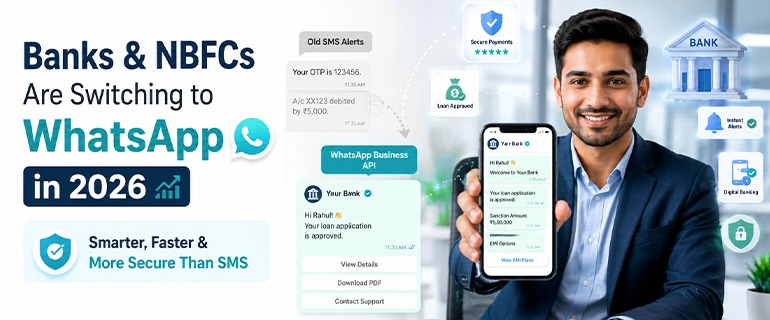
The BFSI sector has witnessed significant changes in recent years. People do not need delays in their actions, complex help systems, or navigating apps for performing any straightforward tasks.
They expect:
And more and more often, they demand all of this from channels they already rely on day-in and day-out.
It is precisely because of this change that banks, NBFCs, fintech, insurers, and lenders are turning quickly to WhatsApp Business API for BFSI.
By 2026, WhatsApp is not just an instant messenger anymore. For the financial industry, it has become a complete communication platform that brings together speed, trust, automation, and convenience - things that can't be easily replicated through SMS.
SMS used to be the standard for communication between banks and NBFCs.
It worked well for:
But customer behavior has changed.
Today, traditional SMS faces several challenges:
Users will not bother about SMS messages because their inbox keeps on getting spammed with promotional messages.
People these days have started showing preference for interactive messaging over one way messaging.
Here comes the role of WhatsApp.
Amongst all countries, India has emerged as the largest consumer base for WhatsApp. Millions of consumers make use of WhatsApp daily.
From BFSI perspective, WhatsApp gives an advantage by
👉 customers are already active on the platform.
There's no need to:
Communication becomes natural, immediate, and familiar.
More importantly, WhatsApp offers capabilities that SMS simply cannot provide:
This is why many financial institutions now view WhatsApp as a modern BFSI communication platform rather than just another messaging channel.
One of the biggest reasons banks are moving away from SMS is visibility.
Traditional SMS often gets:
WhatsApp messages, on the other hand, feel more trustworthy and interactive.
Financial institutions report significantly higher engagement rates because:
For BFSI brands, visibility directly impacts:
Security is one of the biggest concerns in financial communication.
Customers today are increasingly cautious about:
WhatsApp offers:
This makes it a stronger option for:
For many institutions, secure messaging for banking & insurance is no longer optional - it's a customer expectation.
KYC and onboarding processes are often where financial institutions lose potential customers.
Traditional workflows involving:
can create significant drop-offs.
WhatsApp simplifies this journey dramatically.
Banks and NBFCs now use WhatsApp for:
Customers can complete many onboarding steps directly within the chat experience itself.
That convenience leads to:
Lending businesses are among the biggest adopters of WhatsApp automation.
NBFCs and fintech platforms use WhatsApp to:
Unlike SMS, WhatsApp allows:
This makes financial journeys feel like journeys rather than transactions.
This is how banks provide clarity to their customers.
It also improves the repayment experience for the business.
Modern customers expect support instantly.
Expanding customer support teams is expensive and challenging.
In such cases, WhatsApp automation turns out to be incredibly beneficial.
With the use of AI chatbots and conversations flows, banks can automate:
Many institutions now use WhatsApp as an extension of their customer support infrastructure.
The result:
Trust has become one of the most important factors in financial communication.
Customers are far more likely to engage with verified WhatsApp communication than random SMS alerts.
WhatsApp helps reduce fraud risks through:
For banks and insurers, this becomes especially important during:
Verified communication improves confidence and reduces hesitation.
SMS is limited to plain text.
WhatsApp enables a much richer communication experience.
Financial institutions can now send:
This makes communication:
For BFSI brands competing on customer experience, this is a major advantage.
India's digital ecosystem is unique.
Many users:
WhatsApp naturally aligns with these behaviors.
For financial institutions, this means:
That's why WhatsApp adoption is accelerating not only among large banks, but also:
| Feature | Traditional SMS | WhatsApp Business API |
|---|---|---|
| Engagement | Moderate | High |
| Rich Media | No | Yes |
| Two-Way Communication | Limited | Full conversational support |
| Verification | Weak | Verified business profiles |
| Security | Basic | Encrypted communication |
| Customer Experience | Transactional | Interactive |
| Automation | Limited | Advanced workflows |
| Support Integration | Minimal | AI + human support |
Financial institutions are no longer looking for simple messaging tools.
They need:
This is why demand for enterprise-grade messaging for banks & NBFCs is growing rapidly.
The focus is shifting from:
❌ sending notifications
to
✅ building intelligent customer communication ecosystems.
Pingverse helps banks, NBFCs, insurers, and fintech companies build secure and scalable communication journeys through a unified omnichannel platform.
With Pingverse, businesses can access:
The platform also supports:
through a single communication ecosystem designed for modern financial services.
The move from SMS to WhatsApp by the BFSI industry is more than just a technological trend; it is indicative of shifting customer preferences as well.
Customers today want:
WhatsApp enables financial institutions to deliver exactly that.
For banks and NBFCs, the future of customer engagement will depend on:
And in 2026, WhatsApp is quickly becoming the channel where all of these come together. 🚀