 Book a Demo
Book a Demo
Book a Demo
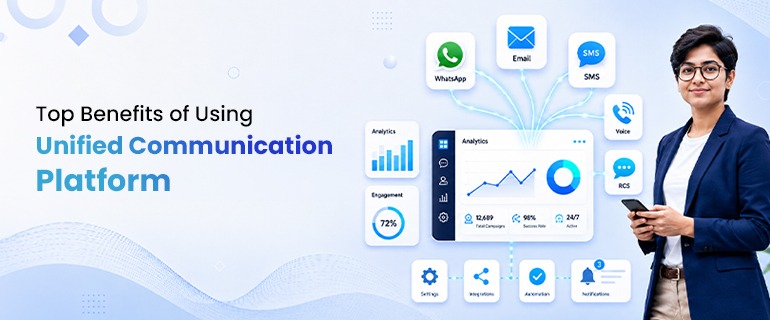
The consumer gets to know your brand through the ad, asks a question on WhatsApp, gets an OTP on SMS, gets the bill on email, and finally contacts you on the phone.
For the customer, it all happens as part of one relationship with one brand.
Inside the enterprise, these conversations may be managed separately using different channels, teams, platforms, and dashboards, resulting in a disjointed experience for the customer - duplicating questions, slow replies, inconsistent information, and distributed customer data.
Unified communications help to resolve this challenge by consolidating various communication channels and workflows within one integrated system.
In the case of Indian enterprises managing large amounts of messages and complex customer experiences, choosing the right CPaaS provider in India will help streamline their processes and enhance each conversation.
A unified communication platform integrates channels such as WhatsApp, RCS, SMS, Email, and Voice under one roof.
Rather than having separate channels working independently, companies have the option to handle everything from one single interface.
This is different from simply offering multiple channels.
A business may use five communication channels and still deliver a disconnected experience. An omnichannel communication system seamlessly enables the exchange of data and context with the customer.
For instance, if a customer is using WhatsApp to communicate with a brand and contacts it through phone call at some other point in time, then the representative on the line should not ask them to start from scratch. The previous interaction should already be visible.
That continuity is what turns multichannel availability into a unified customer experience.
When communication tools operate in silos, teams rarely see the complete customer journey.
Marketing may know which campaign generated the lead. Sales may know what the customer requested. Support may know what went wrong later. But unless those systems are connected, no one has the full picture.
A unified customer engagement platform brings customer interactions together so teams can understand:
It enables businesses to reach out more relevantly and saves from the irritation of repeating themselves or getting into contradiction.
Customers will select channels based on the scenario.
SMS may be preferred for instant OTPs, WhatsApp for fast support, Email for comprehensive documents, RCS for updates, and Voice calls for a problem that requires explanation.
A unified platform makes sure that businesses can follow customer preference without hampering their experience.
Consider a loan application. The customer could receive:
In cases where all the five are channeled through one system, everything is more coordinated and not random.
Customer engagements can be event-driven as well.
An order is placed. A payment fails. A shipment departs from the warehouse. A customer exits the application. An unusual transaction is detected.
With a cloud communication service, it becomes possible to react automatically to these events.
Without having to wait until a message gets sent manually, businesses can set up workflows like:
It saves time and makes sure that the critical communication reaches the customer at the right time.
Managing separate vendors and dashboards creates unnecessary work.
Teams may spend time exporting reports, matching customer records, switching applications, checking delivery logs, or recreating the same workflow across different channels.
A single system eliminates this type of friction.
All functions like marketing, sales, support, and operations can share common data for their communication process instead of maintaining separate data. This will help them start their marketing process faster, solve problems of customers in an informed way, and make decisions without the need to chase data from other departments.
The advantage here is not just efficiency. It is the ability to move from scattered activity to coordinated execution.
Fragmented communication stack comprises distinct contracts, integrations, support, billing, and reporting.
The total cost is not limited to software subscriptions. Businesses have to take into consideration maintenance costs related to integration, employee training, coordination of vendors, effort spent on reporting, and errors made due to a lack of integration of systems.
Unified communication will allow you to cut such hidden costs.
In addition, it will provide predictable costs and help to scale up your communication infrastructure without having to constantly build it from scratch.
The process of personalisation becomes tough when customer information is scattered across multiple channels.
A unified system helps the system leverage customer behavior, preferred channels of communication, prior communication history, purchases, and lifecycle stage to figure out what comes next.
A first-time customer may need onboarding guidance. An active customer may need a service update. A dormant customer may need a carefully timed re-engagement message.
The objective is not to send more communication. It is to make each interaction more relevant.
This is particularly crucial for businesses dealing with thousands or millions of customers at various lifecycle stages at the same time.
A unified platform gives businesses a clearer view of communication performance across channels.
Teams can compare:
This helps in determining the suitability of using either Email, SMS, WhatsApp messages, RCS campaigns or Voice calls for specific use cases.
Rather than making assumptions, businesses can enhance the experience using real consumer behavior.
Communication requirements change quickly.
A festival campaign may produce a sudden rise in enquiries. A product launch may require high-volume messaging. A new branch or market may add thousands of customers. An urgent event may require immediate notifications across several channels.
Cloud-based communication infrastructure can scale more easily than disconnected legacy systems.
Businesses are able to scale up by adding channels, processes, users, and messages without having to redesign the whole system. Therefore, a consolidated platform is ideal not just for larger businesses but also for smaller firms looking to scale up.
The information exchanged with the customers is confidential, especially in banks, insurance, healthcare, loans, and e-commerce.
Using personal gadgets or using unauthorized software means creating visibility and management gaps.
A unified platform keeps communication within governed business systems. It can allow the use of templates, access control, consent, tracking of delivery, verification of senders, auditing, and security integration.
It enables businesses to gain the trust of their customers while maintaining control.
Read: Top 5 Use Cases of RCS for E-commerce, Banking, Healthcare & Service Industries
Pingverse merges WhatsApp, RCS, SMS, Email, and Voice into one smart communication platform.
Enterprises can use Pingverse to automate the customer journey, for transactional messages, personalised campaigns, bulk communication, and cross-channel interactions.
In contrast to other solutions that require enterprises to communicate in silos, Pingverse enables companies to coordinate their communication strategy on a CPaaS platform in India.
The idea behind the solution is simple: Send the right communication at the right time.
The real value of a unified communication platform isn't just about grouping multiple channels onto a single dashboard.
The actual value is of unifying customer context, workflows, data, teams, and channels together into a coherent experience — which is exactly what Pingverse is built to do.
Businesses will benefit in terms of reduced complexity, increased speed, greater visibility, and increased scalability.
Customers will benefit in terms of receiving answers to fewer repeated questions, relevant communication, fast answers, and a cohesive experience with the brand throughout their journey.
In an era where communications are becoming ever more fundamental to digital architecture, businesses that align their communications with a platform like Pingverse are the ones who would get ahead in service to their consumers.
A unified customer engagement platform is a single platform that connects all the customer communication channels, data, automation, and analytics so that businesses can manage the customer experience.
Multichannel communication provides many channels; however, they might operate independently. The omnichannel communication platform links those channels and keeps the context of the customer across those channels.
It enables businesses to automate their communication, scale their messages, integrate the system, and control all the channels without requiring any on-premise communication infrastructure.
Pingverse provides customer communication through WhatsApp, RCS, SMS, Email, and Voice channels.
Yes. A CPaaS platform provides scalable communication infrastructure to growing businesses that will keep growing along with the growing customer base.