 Book a Demo
Book a Demo
Book a Demo
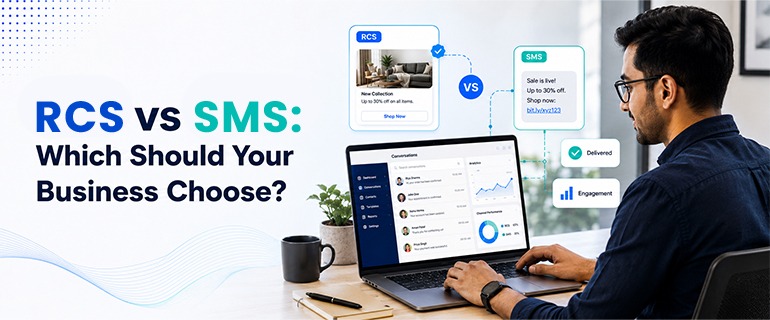
So much has changed in the area of business communications in recent times. The consumers do not want just the information anymore; they desire interactive and personal conversations.
Be it order confirmation, promotions, bill reminders, customer inquiries, or anything else, all messages contribute to creating the experience of the customer. That is precisely why businesses have to do away with usual messaging platforms and look for something better.
The first thing that comes to mind in such circumstances is whether your business should continue using SMS or switch to Rich Communication Services (RCS).
It is important to note here that this is not the case of exchanging one platform with another but finding the one that best suits your purpose.
In this guide, you will be provided with a comparison of RCS vs SMS along with their respective advantages and disadvantages.
SMS (short message service) has formed the foundation of cellular communications through many years of usage. In spite of the emergence of other forms of messaging, it remains one of the most dependable ways for companies to communicate with their clients.
Contrary to messaging services that work on the internet, SMS works on all mobile phones irrespective of brand and does not need internet connectivity. This aspect of SMS makes it extremely useful for sending messages in emergencies.
Businesses commonly use SMS Marketing and transactional messaging for:
One of the key advantages of SMS lies in the fact that it can be sent instantly no matter what mobile phone your customer uses.
With changing customer expectations, SMS messaging has its drawbacks as well.
Only messages in text form can be sent using SMS messaging. This implies that businesses will not be able to send messages which include images, videos, buttons, or branding. The use of SMS messaging will not be enough to offer an experience that is immersive to consumers.
Rich Communication Services (RCS) is the next generation of business messaging.
Think of it as an upgrade to SMS.
Instead of sending only plain text, businesses can create conversations that feel more like a mobile app experience, without asking customers to download another application.
Using Rich Communication Services, brands can send:
These kinds of experiences are available to customers within the default messaging app that they use.
For businesses, RCS changes the face of messaging by turning it from a notifications channel to an engagement channel.
Just imagine receiving a booking confirmation for a restaurant through which you could re-book with just one click, or a promotion through which you could explore the product range within the chat itself. That's the kind of experience RCS enables.
| Feature | SMS | RCS |
|---|---|---|
| Internet Required | No | Yes |
| Device Support | Nearly all mobile phones | RCS-enabled devices |
| Media Support | Text only | Images, videos, GIFs, documents, carousels |
| Business Branding | No | Verified business profile, logo & brand colours |
| Interactive Buttons | No | Yes |
| Read Receipts | Limited | Yes |
| Typing Indicators | No | Yes |
| Two-Way Conversations | Basic | Advanced conversational messaging |
| Best Use Cases | OTPs, alerts, reminders | Marketing, customer support, product discovery, commerce |
As seen from the table, the focus of SMS is on reachability, whereas RCS emphasizes enhanced user experience.
The important thing is not to find out which platform is better but which fits your communication demand.
Even though Rich Communication Services are gaining popularity, SMS remains one of the most reliable communication channels available.
The reason is simple: reach.
When a message needs to reach every customer - regardless of their device, operating system, or internet connection - SMS is still the safest option.
The banking sector, fintech firms, and other digital businesses still use SMS for one-time passwords since they are fast and do not require an internet connection.
SMS should be the medium for notifications regarding payments, transactions, and anything pertaining to finance since speed and reliability will outweigh any need for high-quality visuals.
The health care sector, beauty salons, educational institutions, and service-based companies use SMS to avoid appointment no-shows.
It doesn’t matter if it’s a service disruption, weather warning, or an important announcement – SMS is the quickest means for informing your clients.
Promotions, discounts, flash sales, and festivals that require immediate attention are better suited to SMS Marketing than to any other marketing activity.
Additional Reading: Top 7 Enterprise Use Cases of SMS API in 2026
While SMS is built for reach, RCS is built for engagement.
For any time the purpose involves engaging the customer rather than sending a message, RCS provides a substantially enhanced experience.
Instead of sending a plain text offer, businesses can showcase:
Customers can browse products without leaving the conversation.
Rather than sending:
"Flat 30% OFF. Visit our website."
An RCS campaign can display:
making the experience far more engaging.
One of the biggest strengths of Rich Communication Services is conversational support.
Customers can:
All this, that too without switching applications.
This makes RCS an excellent option for two-way messaging for businesses.
Banks and NBFCs can use RCS for:
The verified business profile also helps customers immediately recognise legitimate communications, improving trust.
Retail brands are increasingly adopting RCS for:
Instead of simply informing customers, businesses can encourage them to interact immediately.
Additional Reading: Top 5 Use Cases of RCS for E-commerce, Banking, Healthcare & Service Industries
The most common misunderstanding is that businesses need to go for SMS or RCS.
But the truth is that successful communication strategies have both.
Here's how a modern messaging journey typically works:
| Customer Journey | Recommended Channel |
|---|---|
| OTP Verification | SMS |
| Welcome Journey | RCS |
| Product Catalogue | RCS |
| Payment Reminder | SMS |
| Delivery Tracking | RCS |
| Urgent Service Alert | SMS |
| Customer Support | RCS |
| Promotional Campaign | RCS |
| Fallback Delivery | SMS |
A lot of enterprises today are following an RCS first approach.
If the device of the user supports RCS, then they get the enhanced interactive experience.
Otherwise, the message falls back on SMS.
Such a model brings in the best of both worlds:
SMS is used by banks for sending OTPs and transaction notifications, whereas RCS is used for onboarding processes, loan proposals, repayment reminders, and customer awareness.
SMS handles order confirmations.
RCS highlights product suggestions, offers, and tracking with visual content.
Appointment notifications are sent via SMS.
Pre-appointment guidelines, reports, prescriptions, and customer assistance are shared via RCS.
SMS communicates boarding updates.
RCS facilitates itinerary management, boarding passes, destination suggestions, and customer assistance.
It is unlikely that today’s customers’ paths involve a single communication channel.
They can find out about you from an ad, message you on WhatsApp, get an OTP on SMS, receive invoices by email, and contact you by voice.
Handling each conversation individually results in poor customer experience.
Pingverse brings them together through one intelligent communication ecosystem.
Using Pingverse's Business Messaging Solutions, enterprises can:
Rather than selecting just one method of communications, enterprises have the ability to coordinate communications through a variety of channels and yet at the same time remain consistent with their customers' experience.
The issue of RCS vs. SMS is not about picking a winner.
Each technology solves different business issues.
SMS still remains unparalleled when it comes to reaching customers, thus making it invaluable for critical alerts and transactions.
RCS brings richer interactions and experiences to customers.
The best way forward for most businesses is not to switch to RCS from SMS but rather use both of them.
An approach where RCS is used first and SMS is used as a fail-safe allows customers to have rich experiences where possible, while keeping things reliable for businesses.
With customers' expectations changing, those businesses that would combine intelligent messaging and the appropriate technology will find themselves well-equipped to build better customer relationships.
SMS can only send text messages on any mobile device without needing the internet. RCS is a much more sophisticated form of communication because it offers such elements as multimedia, brand experience, action buttons, read receipts, and conversational experiences.
None is definitely better than another. SMS is perfect for reach and urgent communication while RCS suits well for customer engagement, product discovery, marketing and interactive communication.
Yes. There are many companies who use RCS for their main messaging service but automatically fall back to SMS in case if RCS is not available on the other end.
Retail, ecommerce, banking, fintech, healthcare, travel, education and logistics can benefit from RCS technology the most since it provides richer and personalized customer interaction experience.
Modern Business Messaging Solutions allow delivering personal, scalable and smart communication on SMS, RCS, WhatsApp, Email and Voice channels leading to higher engagement, efficiency and better relations with customers.You can get such solutions for your business from smart platforms like Pingverse.